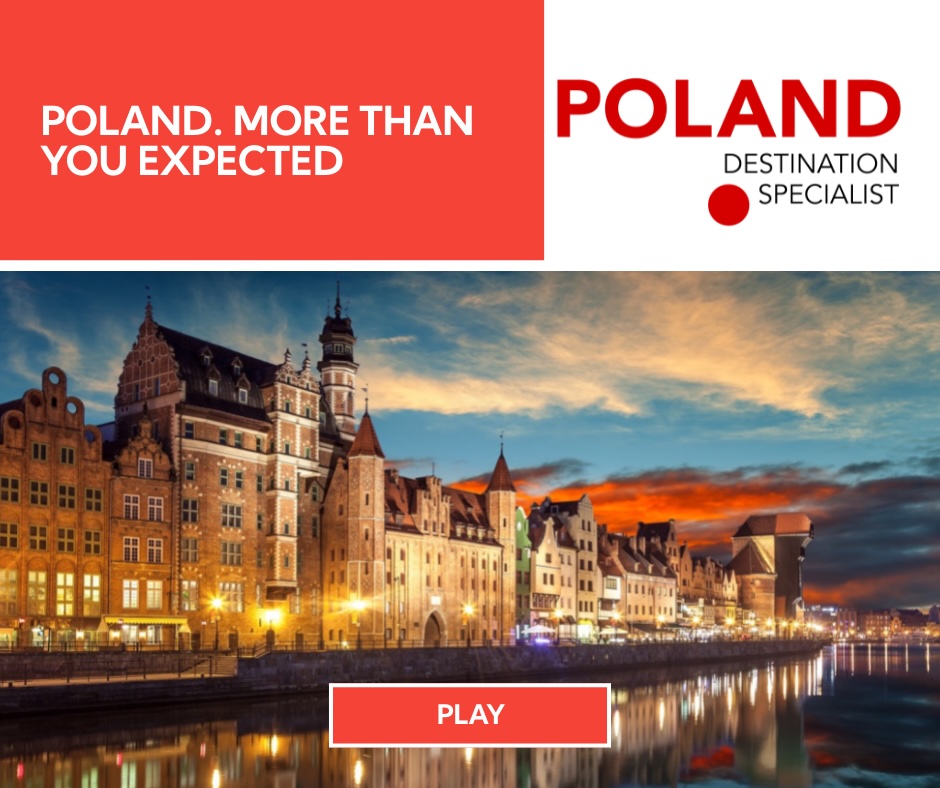

Poland Destination Specialist Program
Program Overview
There are destinations that announce themselves loudly, and then there are those that reveal their power quietly, to those willing to look closely.
Poland belongs to the latter, and the Poland Destination Specialist Program exists for travel advisors who understand that meaning, not noise, is what truly sells a journey. This certification is an essential immersion into a country shaped by continuity rather than spectacle, where UNESCO cities, culinary revival, spa and wellness traditions, pilgrimage routes, outdoor landscapes, and modern resilience form a cohesive, compelling whole. It is designed to sharpen your authority, deepen your storytelling, and give you the confidence to position Poland not as a trend, but as a destination of substance and emotional weight. Each module builds practical knowledge alongside cultural insight, allowing you to craft itineraries that feel intentional and deeply considered.
Upon completion, you will earn digital certification badges to display on your website and professional channels, signaling to clients that you are not simply selling Poland, but truly understand it. This program is not about learning facts. It is about learning how to read a place, and how to guide others through it with credibility, clarity, and purpose.
WhY Poland
Find Your Poland
Poland is a country of remarkable regional diversity, where history, culture, and landscape come together in distinctive ways. From vibrant cities and royal capitals to alpine mountains, forests, lakes, and a storied coastline, each region offers its own character and experiences. Explore these regions to discover the many sides of Poland and find the places that resonate most with your interests and sense of adventure.
- Charming Cities
- Luxurious Getaways
- Delectable Cuisine
- Incredible Landscapes
- Destination Events
Something For everyone
Popular Regions
Memories made as you explore the wonders of the Poland, one incredible journey at a time.
Tap a card to learn more.
Gdańsk
Maritime heritage and Baltic charm
About Gdańsk
Gdańsk rises where the Vistula meets the Baltic, a northern light of Poland shaped by salt air, ship masts, and centuries of seafaring lore. This is the heart of Pomerania, a place where Hanseatic merchants once traded fortunes and the proud rhythms of Kashubian culture still thread through daily life. Together with neighboring Sopot and Gdynia, it forms the Tricity, a coastal world of broad beaches, atmospheric lanes, and the golden glint of famous Baltic amber. It is a gateway, a storyteller, and a city that seems to breathe history with every tide.
Krakow
Royal history and cultural soul
About Krakow
Krakow sits along a graceful bend of the Vistula, a southern jewel shaped by centuries of art, intellect, and quiet wonder. It is the storied heart of Lesser Poland, where royal echoes linger in courtyards and every doorway seems to open into another century. Framed by the limestone uplands to the north and the soft rise of the Carpathian foothills to the south, the city stands at a natural crossroads, a place where ideas, faith, and culture have mingled for generations. Modern yet timeless, Krakow feels less like a destination and more like a grand, unfolding tale.
Warsaw
Where history meets momentum
About Warsaw
Warsaw rises from the broad sweep of the Vistula like a testament to resilience and reinvention, a capital shaped equally by memory and momentum. This is Mazovia’s beating heart, a historic land whose quiet folk traditions contrast with the city’s soaring skyline and restless energy. Here, an Old Town rebuilt stone by stone stands shoulder to shoulder with Europe’s tallest towers, and stories of wartime courage mingle with the hum of trams, theaters, and late-night cafés. Beyond the city limits, the wider Mazowieckie province stretches across central Poland, gathering in storied towns and thriving communities that orbit Warsaw’s magnetic pull. It is Poland’s past and future in a single frame, alive with culture, commerce, and the spirit of a place always moving forward.
Wrocław
Bridges, islands, and beauty
About Wrocław
Wrocław stretches across the islands and bridges of the Oder River like a city spun from light and water, a southwestern crossroads where cultures have mingled for centuries. This is the historic heart of Lower Silesia, a region shaped by shifting borders and layered stories, where Gothic towers rise above market squares and the echoes of Central Europe linger in every corner. As the capital of Dolny Śląsk, Wrocław anchors a vibrant metropolitan world that reaches into the Silesian lowlands and toward the distant Sudeten Mountains. It is a place of academic fire, creative spirit, and quiet architectural wonder, a city that feels both timeless and vividly alive.
Central Poland & Mazovia
Heartbeat of culture and commerce
About Central Poland & Mazovia
Mazovia unfolds across east-central Poland like a vast, living tapestry of rivers, plains, and history. It is the land that gave rise to Warsaw, Poland’s pulsating capital, and Płock, the region’s medieval crown, where echoes of the Piast dynasty still linger. From bustling streets to quiet farmland, Mazovia balances industry, research, and finance with forests, meadows, and the tranquil Kampinos National Park, a UNESCO biosphere that invites exploration. It is a place where Chopin’s first notes floated into the world in Żelazowa Wola and centuries of culture and tradition meet the rhythm of modern life. Mazovia is at once Poland’s historical heartbeat and its forward-looking engine.
Lesser Poland & Silesia
Tradition, industry, and mountains
About Lesser Poland and Silesia
Southern Poland opens like a story written in stone and river. Lesser Poland, with Kraków at its heart, is a world of royal castles, Tatra peaks, and streets alive with centuries of art, faith, and memory. To the west, Silesia stretches along the Odra River, shaped by Polish, German, and Bohemian currents, where Wrocław’s waterways and Katowice’s industrial hum speak of resilience and reinvention. These regions together capture the essence of Poland. Lesser Poland carries the weight of heritage while Silesia pulses with industry and cultural fusion. Both invite travelers to wander through landscapes, cities, and histories that linger long after the journey ends.
Western Poland
River cities and cross-border culture
About Western Poland
Western Poland unfolds along the Oder and the Baltic like a place constantly in motion. It is a land where history and modern life meet, shaped by Polish, German, and Czech influences. Wrocław charms with its islands, bridges, gnomes, and Market Square while Szczecin pulses as a port city with medieval roots. Poznań stands as a bustling commercial heart, and Lubusz offers quiet rivers and national parks for reflection. This is a region of economic energy, cultural fusion, and landscapes that shift from sparkling rivers to coastal resorts. Western Poland feels alive at every turn, a place where the past is present but the future is always just over the next bridge.
The Tatra Mountains
Alpine peaks and highland traditions
About The Tatra Mountains
The Tatras rise like jagged crowns along the border of Poland and Slovakia, the only alpine peaks in Poland and a realm that feels untouched by time. From the bustling streets of Zakopane, travelers step into a world of sharp ridges, crystal-clear lakes, and trails that thread through forests and rocky valleys. Morskie Oko mirrors the sky at the foot of Rysy, Poland’s highest peak, while Siklawa Falls plunges seventy meters in a thunder of water. The mountains are alive with Tatra chamois, marmots, and even the occasional brown bear, and the local Górale people carry traditions as vivid as the alpine landscapes. In summer the trails call hikers, in winter skiers carve their way down slopes, and all year round the Tatras offer a drama of nature and culture that lingers long after you leave.
Northern Poland & Baltic Coast
Seaside towns and amber shores
About Northern Poland and Baltic Coast
Poland’s Baltic Coast stretches like a ribbon of sand, sea, and history along the northern edge of the country. The Tri-Cities, Gdańsk, Gdynia, and Sopot, blend cobblestone streets, amber workshops, and vibrant nightlife with broad beaches and ferry connections to Sweden. Further along, the Hel Peninsula narrows into a windswept playground for windsurfers and kite enthusiasts. Słowiński National Park shifts and rolls with its famous moving dunes. On Wolin Island and at Krynica Morska, cliffs, forests, and quiet sands invite reflection and adventure. Summers are mild, waters inviting, and after storms the shoreline offers tiny treasures of Baltic amber. This is a coast where history, nature, and recreation meet, offering moments both lively and serene for anyone drawn to the edge of the sea.
Masuria
Lakes, forests, and quiet escapes
About Masuria
Masuria, the Mazury Lake District, is a northeastern paradise of water and forest where thousands of lakes shimmer among pine-clad hills. Towns like Mikołajki and Giżycko offer charming bases for sailing, kayaking, or simply drifting along calm waters. History lingers in the stones of Teutonic castles and the shadow of the Wolf’s Lair while wildlife roams freely, from bison in dense forests to birds along quiet lakeshores. Summer brings sailing regattas and sunlit trails, spring and autumn offer solitude and reflection, and every season reveals Masuria’s serene beauty. Here, nature, history, and culture meet to create a landscape both lively and meditative, inviting travelers to slow down and breathe.
Eastern & Southeastern Poland
Authentic culture and heritage
About Eastern and Southestern Poland
Eastern and southeastern Poland unfold like a quiet, hidden chapter of the country, where rolling hills, the Carpathian foothills, and the Vistula River shape a landscape of gentle beauty. Lublin serves as the gateway, its Old Town alive with history and student energy, while Zamość shines as a perfectly preserved Renaissance jewel and Kazimierz Dolny perches on the river as an artsy retreat. These regions carry the weight of centuries, where Polish, Jewish, and Eastern influences intertwine, offering travelers a deep, authentic connection to culture and history. Away from the crowds of the west, the east invites exploration, reflection, and discovery amid landscapes, towns, and stories that linger long after the journey ends.